QuietRock Educational Resources Center

ShareSend to FacebookTweet ThisEmail ThisPrint This

Reliable Soundproofing Building Practices

Building for noise control has become common in today’s construction practices because it increases comfort, positively impacts productivity, and decreases distractions. When building for noise isolation between rooms, there are many important practices to consider. Wall or floor/ceiling isolation methods, absorption treatments, penetration process, and sealants for reducing sound leakage will all impact the overall noise isolation between rooms.

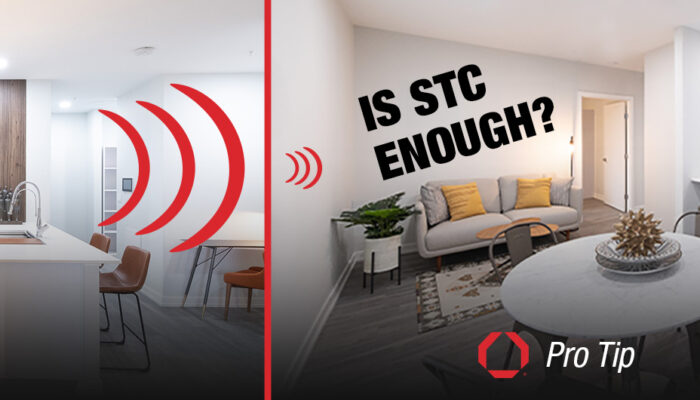
Soundproofing will be frustrating if you do not understand how noise isolation works. Sound follows the path of least resistance just like water or fire. Sometimes it doesn’t matter how you treat a wall or floor/ceiling if the noise is penetrating through a completely different path such as a poorly designed floor, HVAC system, or cracks in seams. The term “soundproofing” is commonly used to describe noise isolation. However, it is important to understand that nothing can be completely “soundproof.” The Sound Transmission Class, or STC, is a single-number rating system for the amount of noise isolation between rooms.

According to a study conducted by the National Research Council (NRC), Canada, an STC rating of 55 is the minimum noise isolation rating that provides occupants comfort. (1Bradley, J.S., Sound Insulation Issues. National Research Council. NRCC-47054)

Although the proper use of an acoustic treatment or system will not completely eliminate noise, it can effectively reduce the noise and create a comfortable indoor environment. Therefore, it is critical to research and understand the noise isolation process and choose a method that provides a complete, reliable solution. When constructing a wall or ceiling assembly a sound absorbing treatment is recommended to improve sound STC.

Tests published by NRC showing the same wall assembly, one with insulation, another without, proves a sound absorbing material (in this case insulation) can improve the sound performance by 4 STC points depending the wall assembly it is installed in, which is noticeable to the human ear. (2Halliwell, R.E.; Nightingale, T.R.T.; Warnock, A.C.C.; Birta, J.A., Gypsum Board Walls: Transmission Loss Data IRC-IR-761 National Research Council (TL-93-032 & TL-93-058)) Therefore, insulation is critically when building a acoustic room. Also, in many soundproofing assemblies installed today, sealing air gaps with acoustical sealant and treating penetrations such as outlet boxes is often forgotten or disregarded as unimportant.

This is unfortunate because cracks and holes allow noise to pass through your assembly and can dramatically reduce the overall STC rating.

According to The Noise Control Manual for Residential Buildings, a partition that is expected to provide an STC 50, but has a crack that is 1/8 inch wide by 9.3 feet long, will only achieve an STC 30. (3David Harris. Noise Control Manual for Residential Buildings. McGraw-Hill (1997)) A small crack can have a large negative impact on tenant comfort. It is important to make sure your assembly is airtight. Do not waste your time and money on an assembly that is sure to fail!

Electrical outlets are located in nearly every building structure. Unfortunately, they are often poorly placed and left unsealed. Research completed by NRC has proven that the placement of electrical boxes significantly affects the noise isolation in your assembly. Poorly-placed outlets can decrease the STC ratings by up to 6 points, which is a noticeable difference to the human ear. Untreated outlet boxes can also lower the STC rating. (4T.R.T. Nightingale, J.D. Quirt and M.A. Sultan. Effect of Electrical Outlet Boxes on Sound Isolation of Gypsum Board Walls. National Research Council. Construction Technology Update No . 27) Therefore, using acoustic putty or other noise isolating material around penetrations is a valuable addition to the soundproofing system.

The Quiet Soundproofing System is a high-performing, dependable solution comprised of advanced products that are engineered to work together. QuietRock is designed to offer a simple wallboard installation that can reduce the risk of failure versus more traditional methods. However, even when you use QuietRock, it is still essential to use acoustical sealant and putty for potential sound leaks, outlet boxes, and other openings. The Quiet Soundproofing System consists of products that work in tandem to isolate noise and reduce sound leakage, making it the professionals’ choice for noise isolation. Provide a reliable assembly, create quiet rooms, and improve the indoor environment in your buildings with QuietPutty, QuietRock, and QuietSeal Pro: the only soundproofing solution engineered to work together for the highest performance and the most reliable results.

The Quiet Soundproofing System

QuietRock: Reduce Noise between Rooms

QuietRock is the first damped panel that is manufactured with a soundproofing glue to treat unwanted noise that penetrates into rooms. When sound comes in contact with QuietRock, the inner visco-elastic layer works together with the outer layers (gypsum or other composite) converting acoustic energy into thermal energy (heat), which cannot be heard.

QuietSeal Pro: Seal the Gaps and Stop Noise Leaks

QuietSeal Pro acoustical sealant is a non-hardening caulk that remains flexible to maintain high acoustic performance in your project. It is simple in application and even easier clean-up. Choose QuietSeal Pro for fast installation, maximum performance, and reliable results.

QuietPutty: Wrap Electrical Outlets and Prevent Noise Leaks

QuietPutty is a soundproofing pad that is designed to fit around electrical boxes and other penetrations in your assembly. It is fire rated, easy to use, and a key component in the Quiet Soundproofing System.

Quiet Soundproofing System Benefits

  • Proven performance: one sheet of QuietRock EZ-SNAP with the complete soundproofing system can achieve ICC G2-2010 Grade performance
  • Better soundproofing: outperforms multiple layers of drywall and other noise control such as resilient channel
  • Reliable soundproofing: cannot be easily short circuited like resilient channel and engineered to last with no leaks even over time
  • Lower cost: proven superior acoustic performance at a lower total installed cost than traditional methods
  • Easy installation: All components of the system are designed for easy installation and increased productivity, saving time, labor, materials and valuable floor space
  • UL/ULC Certifications: over 100 independent UL/ULC test reports on numerous stud configurations.
  • Full product line: systems for specific applications such as SCIF or mold resistance

©2002-2011 Serious Energy Inc. 1250 Elko Drive Sunnyvale, CA 94089