“I want a home theater that is my own private world – I don’t want to disturb other people at home (or my neighbors), and I don’t want outside noise to disturb my movie-viewing pleasure.”
This paper is organized to help you get a handle on these common problems and complaints. In five steps, you’ll learn:
The fundamental question you’ll answer for yourself is “what STC rating do I want for my home theater, and how do I get it?” The decision begins with an understanding of STC ratings.
Sound Transmission Class (STC) is the single number rating that describes the sound reduction of a wall or ceiling. It is almost universally used by architects, designers, manufacturers, contractors and distributors of acoustic building products. The STC rating of a partition is measured in accredited laboratories using ASTM E413 and ASTM E90 standards. It is important to note that these measurement criteria have been changed significantly over the years, so measurements from before the late 1990’s may be significantly different than those taken today, and thus should not be relied upon. Generally the higher the STC rating, the greater the sound reduction of the acoustical barrier. STC is essentially the weighted noise reduction (in decibels) through a barrier over a range of frequencies (from 125Hz to 4000 Hz). An STC rating loosely corresponds to the average noise reduction, measured in dB, achieved by an isolating partition, separating the sound in one area and a listener in an adjacent area. For example here are some common noises:

A quality home theater can produce sounds as loud as 100dB to 120dB. A typical “quiet room” is 30 to 40dB. So to have a quiet room at 40dB adjacent to a loud home theater with a noise level of 110dB, a wall would have to be rated with an STC of 70 or more (110 – 40 = 70).
Typical existing wall construction (the most common method is stud construction with drywall on either side) has an STC rating of 30 to 34. A room built with standard construction walls adjacent to the home theater would have sound levels at 76dB (110 – 34 = 76). This level is typical of a factory and is far too loud for conversation or relaxation. However, with a wall built to an STC of 70, the adjacent room would be very quiet, with a sound level of 40dB.
Based on your home theater producing peaks of 100 to 120dB, the table below shows the Sound Transmission Class (STC) target values of partitions needed between the home theater and the adjoining rooms to keep everyone happy. Conversely, you can read the table as the STC needed to keep the home theater occupants from being distracted by outside noises like traffic, or neighbors. The four levels shown below are achievable targets. Each one dictates a different construction method, and hence construction budget. It’s perfectly reasonable to shoot for intermediate target STCs, such as 60. Achieving an STC of 70-80 is world-class, but required for top-rated home theaters.

STC is a basic method of determining wall transmission loss performance. However, when considering walls for home theaters, loss factors at very low frequencies (below 125Hz) are a major consideration. The STC measurement method does not include such low frequencies in the final calculation. To see these, one must obtain the “TL” (or total loss) measurements at 1/3rd octave bands down to 50Hz. A typical interior wall has a loss of 10dB to 20dB at 50Hz to 125Hz. The target is at least 40dB to maintain a quiet environment outside the room. The following chart shows the lab tested performance (loss in dB) of various assemblies at low frequencies (higher is better). All tests are on 24OC wood stud walls except as noted.

There are two basic approaches to sound treatments for home theaters: sound barriers and sound absorbers.
Sound barriers reduce sound transmission from one space to another. Traditional sound barriers follow Mass Law, which states that the heavier an object is, the more energy it takes to vibrate it. Eight inches of solid concrete is considered an excellent sound barrier. Other sound barriers include walls constructed using non-standard methods, such as staggered and double stud walls, or the incorporation of resilient channels. These are expensive and prone to being ruined by faulty construction.
Many people have serious misconceptions about how to create a proper sound barrier. Some common misconceptions are given below.

Sound absorbers reduce the noise due to reflections (echoes or reverberation) within a space. Sound absorbers are usually some kind of foam, fiberglass, fabric or other “fuzzy” material. Foam panels and fabrics, placed on walls and ceilings, are popular examples. A sound absorber reduces echo or reverberation in a room by absorbing a portion of energy each time a sound wave hits it. Therefore, they are effective for reducing sound within a home theater. However, they do not offer much sound reduction through the theater walls, so they do not make good barriers. When used alone, sound absorbers in your home theater will continue to allow sound to be transmitted outside your room to adjacent rooms or even to your neighbors’ homes.
There are a variety of techniques to reduce noise and vibration in a home theater or media rooms. Most approaches rely on one of two principles: mass or damping. Both methods can be effective, depending on how much material you are willing to use. The more the source can be treated, or isolated with airtight barriers treated with viscoelastic or mass-loaded techniques, the better the opportunity to meet your needs for quiet.
Serious Energy has developed a series of advanced technology drywalls and woods designed for superior noise reduction. They use a patent pending viscoelastic polymer approach with “ constrained layer damping” to fundamentally change the way sound moves through walls, ceilings and floors. Basically, damping built into these enhanced panels isolates the face of the wall from the studs. It is as if you built a room-within-a-room, only at a microscopic level. This new sound isolation technology exploits the viscoelastic properties of polymeric materials.
Serious Energy has formulated special compounds that are highly viscoelastic (both viscous and elastic or resilient). When deformed by a sound wave – kinetic energy – the compound’s internal resistance lengthens the time before the material returns to its normal shape. Within a range of temperatures and frequencies, viscoelastic polymers can reduce noise and vibration by 10–20dB per layer or more. Every 10dB of reduction is perceived as a reduction in sound volume of approximately 50%.
If your home theater gets to peaks around 100dB (which is quite loud) then a 20dB reduction through a sound barrier becomes as loud as a telephone dial tone on the other side. There are two types of viscoelastic materials. Unconstrained layer damping is the simplest way of introducing damping into a structure. The treatment consists of a layer of damping material bonded to the surface of the sound-generating source. The coating goes through extension/compression deformation, tracking the bending of the base structure. This forced, simultaneous motion results in dissipation of energy. The material is low cost, typically 1mm thick, and low weight. Constrained layer damping is among the most efficient ways of introducing damping into a home theater. This requires the viscoelastic material to be incorporated into a laminated structure (such as plywood or drywall) and designed for such a purpose.
Materials such as concrete or gypsum board have a certain amount of sound barrier capability because of their heavy weight (mass). With additional layers, there’s more weight, and slightly improved performance. But what about applications where it would be impractical to use layer upon layer of high mass materials? In these situations, using constrained-layer damping rather than mass can yield excellent results. As you’ll see below, a damped drywall or wood panel can achieve even higher STC Ratings than a mass-loaded wall – with less material, less weight and less bulk. In the next section, you’ll learn about the most modern and effective method on the market to build a soundproof room – the Serious Energy Quiet Home Theater System.
Serious Energy has assembled a line of products, which work in concert with each other to give you an unparalleled home theater experience, while preserving the level of quiet in spaces adjacent to the home theater. The six products in the Home Theater System are designed to perform far better than traditional approaches, while remaining low cost, low weight, low bulk, and easy to install.
QuietRock - soundproof engineered panels for walls & ceilings
QuietWood - soundproof panels for sub-floors, exterior walls & booths
QuietSeal - soundproof acoustical sealant for joints & outlets
QuietGlue - Viscoelastic glue for do-it-yourself applications
QuietPutty - soundproof putty pads for junction boxes and electrical outlets
QuietCoat - soundproof coating for HVAC ducts
These elements are used throughout a home theater in conjunction with one another.

A typical home theater installation showing Serious Energy Soundproofing Home Theater elements.
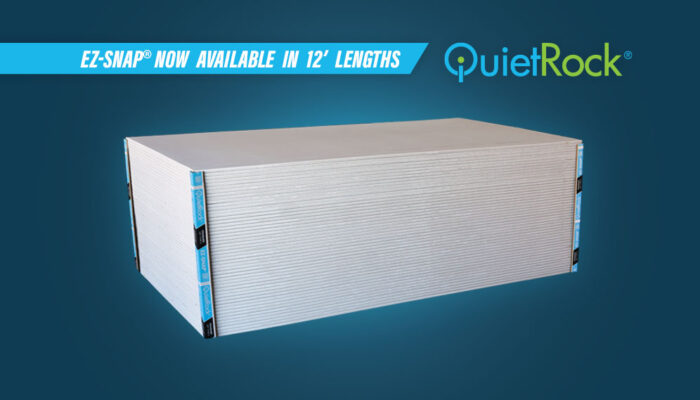
With the highest STC rating of any drywall product, the QuietRock product line significantly reduces noise and sound entering or exiting a room, as part of standard new construction or over existing walls. QuietRock is a multi-layer acoustic isolation drywall product. It is ideal for designs requiring high acoustical performance using very little floor space.
QuietRock 510 is an entry-level internally-damped ??” thick panel, providing high performance at the lowest possible cost. 510 is available in a standard 4' x 8' panel (or 9, 10 and 12’ length by special order). It can replace standard drywall or be installed over existing drywall. It scores, snaps, hangs and finishes just like standard drywall. Walls and ceilings can be easily constructed with STC ratings of 47–52 using basic construction techniques or in the mid-60s if added to double stud walls.
QuietRock 525 is the next step up in soundproofing performance. This 5/8” panel delivers STC ratings of 51-55 on single stud walls, or up to 72 when used with double-stud walls. QuietRock 530 is a high performance panel delivering STC ratings of 52-74. This product is regularly stocked throughout North America at over 1,000 dealer locations. It is also one of the most tested architectural transmission loss systems available, and has been used in thousands of projects.
QuietRock 545 has all the features of QuietRock 530 but is a much higher performance Ceramic-Polymer-Gypsum composite internally damped panel. The result is the most complete isolation design available, with more damping than QR-530. QuietRock 545 delivers STC ratings from 56–80, and features the highest low-frequency performance ever measured in an interior wall system.
Serious Energy Quiet specialists and dealers can help choose the right materials for a project and budget.
With the highest STC rating of any wood product, the QuietWood product line significantly reduces unwanted noise and sounds entering or exiting from the home’s floors, exterior walls or from adjacent rooms. QuietWood is a multi-layer product, and is ideal for use in either existing or new construction.
QuietWood 630 is a higher performance panel only 5/8 inch thick for use in retrofit with QuietFoam.
QuietWood 631 is a structural subfloor product that is 1-1/8” thick.
QuietWood 640 is a high performance internally damped wood product featuring outstanding low frequency performance.
Sound, like water, will travel through any available opening. We have developed QuietSeal acoustical sealant to combat this common flaw in sound barriers. QuietSeal helps your home theater maintain high STC values when used in conjunction with QuietWood and QuietRock.
Use QuietSeal between panels, and to seal perimeter joints where the panels meet the floor and ceiling. QuietSeal is highly resilient and can therefore withstand movement normally encountered by partitions.
When labor is not an issue, excellent performance can be had by using QuietGlue between 2 layers of 5/8” drywall on one or both sides of single wood stud walls. If using your own ‘free’ labor, this may be the lowest cost method to achieve STC’s in the mid 50’s.
Use QuietPutty around electrical, cable, telephone and speaker outlet boxes. Typical steel and plastic enclosures are thin and have many penetrations resulting in a poor barrier to noise. A backing layer of QuietPutty will ensure that a high-performance wall is not harmed by necessary penetrations such as junction boxes or outlets.
QuietPutty is easy to apply at normal working temperatures, and will adhere well to all clean surfaces without priming.
Your sound system isn’t the only source of noise in your home theater. QuietCoat is an unconstrained-layer damping product, meaning it can be applied to the exterior of nearly anything to minimize noise and vibration.
QuietCoat has a broad functional temperature range, which makes it perfect for use on HVAC ducts and lighting fixtures, where temperatures can reach extreme highs and lows. This product is designed to minimize the interference from these necessary building systems, while allowing you to enjoy the full, true sounds produced by your home theater system. QuietCoat is less expensive, easier to apply, more effective, thinner, and lighter than older sound and vibration damping technologies.
In new construction, using metal studs improves the acoustic damping provided by the wall frame itself. However, low frequency exterior noise can actually vibrate an entire wall. By applying QuietCoat to the steel studs, a few additional STC rating points can be achieved.
In the next section, you’ll learn about various construction methods to help you achieve the STC rating you want. This decision is the most important one you, your architect, designer or builder needs to make.
Wood Stud Summary
The table below summarizes the results you can expect from using the different construction techniques outlined above with wood studs. Select the one that most closely matches your goals and budget.

In the past, older technologies utilizing fiberboard (such as Homasote®*) or vinyl barriers have been used to gain marginal improvement in STC values. It is important to note that STC values of materials do not add up. In other words, adding a 27-STC-vinyl barrier to a wall that has an STC of 34 does not result in an STC of 61 (actually, it only raises the STC of the final assembly by 3-9dB). The table below summarizes the results you can expect from using various techniques.

A. QuietRock Panels
QuietRock hangs and finishes just like standard drywall. Any drywall subcontractor can install it, and no special skills are required.
Using QuietRock in Existing Wall Construction
1. QuietRock can be used directly over existing drywall construction without removing the original drywall. Hang as described above.
B. Using QuietGlue
QuietGlue is often used when labor cost is not part of the equation (such as the DIY, or do-ityourself market).
QuietGlue is used BETWEEN panels to create a sandwich. This sandwich is internally damped and will perform well on a low budget when labor, time and floor space are not a concern. Simply use 2 tubes of QuietGlue (58oz total) in any random pattern between 2 layers of 5/8” drywall (or any thickness). Then hang the resulting “sandwich” as normal, with long enough screws to secure to the studs.
Using a little less or a little more will not affect results.
SEE QUIETGLUE APPLICATION NOTE FOR COMPLETE DETAILS
Acoustical & Architectural Technical Support
If you have any questions during installation, contact our acoustic product specialists at 800-797-8159. Complete architectural binders are available to qualified architects and engineers.
Building a home theater involves some important decisions. A great place to start your search for a home theater contractor is with industry organizations:
HTSA - Home Theater Specialists of America
CEDIA - Custom Electronic Design & Installation Association